Truck Air Brake Fade on Long Descents: Causes and Prevention
On a long downhill grade, a truck can lose braking effectiveness even while its air-pressure gauges remain in the normal operating range. Repeated or continuous service-brake use can generate heat faster than the brakes can release it, leaving the driver demanding more braking while the vehicle continues to gain speed.
The main prevention is to enter the descent at a controlled speed, in an appropriate gear, with engine braking or a retarder carrying as much of the continuous braking load as conditions allow. Service brakes then manage speed within the vehicle manufacturer’s recommended downhill procedure. Once braking effectiveness begins to deteriorate, the priority changes from managing the descent to reaching a safe escape or stopping location—not testing whether another application will restore normal performance.
Normal air pressure does not mean normal stopping power
In air-operated Commercial Vehicle Braking Systems, compressed air supplies the force that applies the foundation brakes. Friction at the drums or discs converts vehicle motion into heat. Adequate air pressure confirms only part of that chain: it does not establish that the friction surfaces, adjustment, or individual wheel brakes can produce the required braking torque.
As temperatures rise, friction material can become less effective. On drum brakes, thermal expansion of the drum can also increase the movement required to bring the linings into contact. A brake already near its adjustment limit has less margin to accommodate that change. Air disc brakes generally manage heat and maintain running clearance differently, but they are not immune to overheating, friction fade, or heat damage.
A driver may notice that the same brake application no longer holds speed, or that progressively greater application pressure is needed. Unlike a hydraulic vehicle, an air-braked truck may not provide a distinctive “soft pedal” warning. Brake odor or smoke is a serious warning, but fade can develop before either becomes apparent.
Separate heat fade from an air-supply problem
Both conditions can reduce stopping capability, and they can occur together. The useful distinction is whether braking torque is deteriorating despite available air, or whether the system cannot maintain the pressure needed to apply the brakes properly.
These are warning patterns, not a roadside diagnosis. Drivers should not make repeated hard applications on a descent to identify the fault. Reservoir gauges do not display individual brake temperature, lining condition, or trailer brake contribution.
Where the excess heat comes from
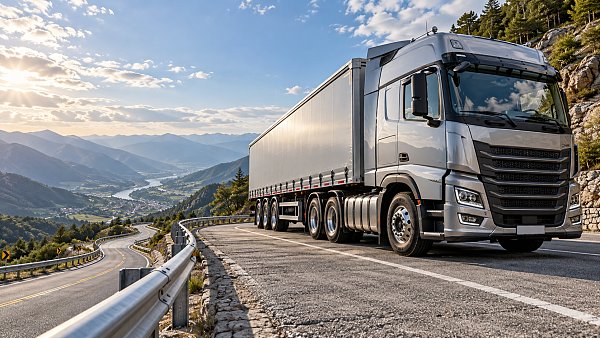
A loaded combination descending a sustained grade must continuously dissipate energy. Greater actual mass, a steeper slope, and higher road speed increase the braking demand. A descent that starts comfortably can become unmanageable if the truck enters too fast and its auxiliary braking cannot hold the selected speed.
Light, continuous pedal pressure is not harmless. It can maintain heat input without allowing useful release periods. Conversely, repeated unnecessary applications can consume air and also add heat. The objective is not simply to apply the pedal less often; it is to reduce the share of downhill energy that the service brakes must absorb.
Mechanical imbalance makes the situation worse. An inoperative trailer brake, excessive pushrod travel, seized caliper components, or contaminated friction material can shift work onto other brakes. A dragging brake may begin the hill already hot. Tractor and trailer braking compatibility also matters: a combination that feels acceptable on level roads may reveal unequal brake contribution during sustained braking.
ABS does not prevent thermal fade. It manages wheel slip during braking; it does not increase the thermal capacity of the drums, discs, or linings. Electronic braking controls likewise cannot compensate indefinitely for overheated friction surfaces or defective foundation brakes.
Set up the descent before crossing the crest
- Assess the route and actual load. Consider grade length, steepness, curves, visibility, road surface, and signed restrictions. Know where brake-check areas and escape ramps are located before committing to the hill.
- Reduce speed while the truck is still controllable. Choose an entry speed that leaves margin for the loaded combination and available auxiliary braking. The posted limit is not a guarantee of a safe descent speed.
- Select the appropriate gear or transmission descent mode. Follow the vehicle manufacturer’s guidance. Avoid entering in a high gear with the expectation that a downshift will remain available after speed builds.
- Establish auxiliary braking early. Select the engine-brake or retarder setting appropriate to traction and vehicle instructions. Confirm that speed is stable rather than waiting for excessive acceleration.
- Preserve room to react. Increase following distance and avoid a speed that depends on the vehicle ahead continuing without interruption.
A simple “use the same gear as the climb” rule is not sufficient for every modern powertrain or load. Engine speed limits, transmission logic, retarder capability, and the direction of travel all affect the choice. Never coast downhill in neutral or with the clutch disengaged.

Auxiliary braking has limits
Engine brakes and retarders reduce service-brake heating, but their available performance varies with engine speed, selected gear, and system design. Some retarders are also constrained by cooling-system temperatures and may reduce output to protect components. Watch the relevant warnings and temperature indications rather than assuming the initial braking level will remain available throughout the descent.
On slippery surfaces, auxiliary braking can cause loss of traction, particularly at the driven wheels. Follow the vehicle’s instructions for low-grip conditions and use smooth inputs. A maximum retarder setting is not automatically the safest setting on ice, snow, or other low-friction surfaces.
Use service brakes to control speed, not carry the whole hill
With the correct gear and auxiliary braking established, follow the downhill service-braking method specified in the driver training and vehicle instructions applicable to that truck. Where controlled intermittent or “snub” braking is prescribed, the purpose is to reduce speed with a deliberate application, then fully release the service brakes between applications while auxiliary braking continues.
There is no universal pedal pressure, application duration, or speed reduction suitable for every truck and grade. Releasing the brakes provides cooling opportunity, but it cannot cancel an excessive average heat load. A truck needing increasingly frequent applications is warning that its descent speed, gear selection, auxiliary braking, or brake condition is inadequate.
Do not use the trailer hand control to hold the combination back down a hill. It concentrates braking work on the trailer, can overheat those brakes, and can destabilize the combination. Likewise, repeated rapid pumping is not a cooling strategy and can deplete the air supply.
Watch the speed trend, not just the current speed. A stable truck should not require steadily greater service-brake demand to remain under control. Do not wait for smoke, a warning lamp, or a dramatic loss of deceleration before responding to deterioration.
When the brakes stop holding speed
Treat increasing speed despite braking as an emergency. Keep attention on the road and escape options. Use available engine braking or retardation within traction and engine-speed limits, and follow the vehicle’s emergency braking procedure. Do not force a downshift that risks engine overspeed or loss of drive engagement.
Use a designated escape ramp promptly when the truck cannot maintain a safe speed; do not pass a suitable ramp hoping braking will recover. Signal or warn others when practical without distracting from vehicle control. Avoid abrupt steering inputs that could cause a rollover or jackknife.
During an emergency stop in an ABS-equipped vehicle, apply and maintain firm service-brake pressure as directed by the manufacturer rather than pumping to “help” ABS. ABS cannot restore friction lost through overheating, so do not delay taking an escape route while expecting it to solve the problem.
Do not pull the parking-brake control as a routine response to fade. Spring brakes act through foundation brakes that may already be overheated, and their application can create instability. Any emergency use must follow the vehicle-specific procedure; they are not an independent, cool backup braking system.
After stopping: cooling is not proof of recovery
Once stopped in a safe location, secure the vehicle according to its instructions and the site conditions. Parking-brake use around severely overheated brakes requires vehicle-specific guidance; simply releasing the brakes on a grade can create a rollaway hazard. Chocking and inspection must not expose anyone to moving traffic or an unsecured vehicle.
Keep clear of hot wheel ends, smoke, and damaged tires. Do not touch drums or discs, crawl beneath an unsecured combination, or spray water onto hot brakes. Suspected fire requires emergency assistance and the applicable fire-response procedure.
There is no reliable universal cooling time that makes an overheated truck ready to travel. Surface temperature alone cannot confirm that linings, seals, bearings, tires, and brake components remain serviceable. Braking may seem stronger after cooling while the underlying defect or heat damage remains.
Before returning to service after significant fade, smoke, or abnormal heating, qualified maintenance personnel should inspect the affected system. Relevant checks include friction-material condition and thickness, drum or rotor condition, actuator stroke where applicable, adjuster operation, caliper movement, air leakage, and brake contribution across the combination. Repeated manual adjustment of an automatic slack adjuster is not a repair for an underlying fault.
Record the load, grade, gear, auxiliary-brake setting, air-pressure behavior, and whether the problem affected the whole combination or appeared localized. Those details help distinguish excessive downhill demand from a defective brake, poor adjustment, or uneven tractor-trailer braking. The next descent should not become the test of whether cooling alone fixed the problem.
Send us a message
Related News
 Maintenance & TCORepair or Replace Commercial Trucks? Using Downtime and Cost per MileCommercial Trucks: repair or replace? Compare downtime, cost per mile, and future ownership costs to make smarter fleet decisions. Discover when repair pays and replacement wins.MORE+
 Medium-Duty Delivery TrucksSizing Commercial Trucks for Urban Delivery: Payload vs. Cargo VolumeSize Commercial Trucks for urban delivery with confidence. Compare payload, usable cargo volume, axle limits, and route access to choose the right fit and avoid costly extra trips.MORE+
 Highway Truck TractorsUsed Tractor Truck Inspection: Engine Hours, Fifth Wheel, and FrameBuying used Tractor Trucks? Learn how to verify engine hours, inspect fifth-wheel wear, and spot frame damage to avoid costly surprises and buy with confidence.MORE+
 Highway Truck TractorsTractor Truck Axle Ratios: Balancing Highway Fuel Use and Hill StartsTractor Trucks axle ratios affect fuel use and loaded hill starts. Learn how to compare gearing, verify launch capability, and choose a powertrain that fits your routes.MORE+
 Technology & Performance BenchmarkHow Semi-Trailer Axle Position Changes Kingpin Load and Axle WeightSemi-Trailers: Learn how axle position changes kingpin load and axle weight. Explore practical calculations to balance loads, avoid overloads, and choose the right setup.MORE+
 Box SemitrailersDry Van or Curtainsider? Choosing Semi-Trailers for Pallet FreightCompare Semi-Trailers for pallet freight: dry vans vs. curtainsiders. Discover which loading options, cargo protection, and operating costs best fit your routes before you buy.MORE+
 Full TrailersFull Trailer Coupling Checks: Drawbar Wear, Locking, and Safety ChainsFull Trailers need secure couplings for safer dispatch. Learn how to check drawbar wear, verify locking, and inspect safety chains to spot defects before they put your fleet at risk.MORE+
 Full TrailersWhat Is a Full Trailer? Axle Support, Drawbars, and Common UsesExplore how Full Trailers support loads, use drawbars, and compare with semitrailers. Discover common uses and key operating factors to choose the right setup for your freight needs.MORE+
 Refrigerated SemitrailersBuying Refrigerated Trailers for Multi-Temperature Food DeliveryBuying Refrigerated Trailers for multi-temperature food delivery? Compare layouts, cooling capacity, payload and lifetime costs to protect food quality and choose the right fit for your routes.MORE+
 Refrigerated SemitrailersRefrigerated Trailer Temperature Swings: Airflow or Unit Failure?Refrigerated Trailers showing temperature swings? Learn how to distinguish airflow issues from unit faults, protect cargo, and avoid costly repairs with practical diagnostic checks.MORE+
 Driver Assistance & SafetyFlatbed Trailer Load Securement: Preventing Steel Coil MovementFlatbed Trailers: Learn how to prevent steel coil movement with proper cradles, rated tiedowns, and load checks. Explore practical steps for safer, more confident dispatch.MORE+
 Flatbed & Lowbed SemitrailersSteel vs. Aluminum Flatbed Trailers: Payload Gains and Repair CostsCompare steel vs. aluminum Flatbed Trailers for usable payload gains, repair costs, and downtime. Discover which option delivers better value for your fleet.MORE+
 Routing & Capacity PlanningPlanning Lowboy Trailer Moves: Ground Clearance, Grades, and Site AccessPlanning moves with Lowboy Trailers? Learn how to assess ground clearance, grades, traction, and site access to avoid costly delays and keep equipment deliveries on track.MORE+
 Flatbed & Lowbed SemitrailersChoosing a Lowboy Trailer for Excavators: Deck Height and Load CapacityCompare Lowboy Trailers for excavators with expert guidance on deck height, load capacity, and axle limits. Find the right fit to avoid costly mismatches and plan your next move.MORE+
 Maintenance & TCOWhen Do Electric Trucks Pay Off? A Depot-Based Fleet TCO AnalysisWhen do Electric Trucks pay off? Explore depot-based fleet TCO, charging costs, and break-even factors to identify profitable routes and invest with confidence.MORE+
 Electric Heavy TrucksCan Electric Trucks Complete Your Routes? Payload, Range, and ChargingCan Electric Trucks handle your routes? Learn how payload, real-world range, and charging windows affect fleet performance—and discover what to check before you invest.MORE+
 Policy, Standards & ComplianceFMVSS 121 for Truck Air Brakes: Stopping Distance and Test RequirementsCommercial Vehicle Braking Systems: Understand FMVSS 121 stopping distances, test conditions, and compliance evidence to compare truck air brakes and make smarter fleet decisions.MORE+
 Braking & Electronic ControlsTruck Air Brake Fade on Long Descents: Causes and PreventionCommercial Vehicle Braking Systems can lose stopping power on long descents. Learn brake fade causes, warning signs, and prevention strategies to keep your truck under control.MORE+
 Axles & SuspensionWhy Truck Air Suspension Sags Overnight: Leak Diagnosis and RepairCommercial Vehicle Suspension Systems sagging overnight? Learn to pinpoint air leaks, identify valve faults, and verify repairs before replacing costly parts. Get the diagnostic guide.MORE+
 Axles & SuspensionAir vs. Leaf Spring Suspension for Trucks on Rough Delivery RoutesCommercial Vehicle Suspension Systems: compare air and leaf springs for rough delivery routes. Discover how payload, ride control, and maintenance shape the right truck suspension choice.MORE+