Steel vs. Aluminum Flatbed Trailers: Payload Gains and Repair Costs
Aluminum flatbed trailers are usually the stronger candidate when loads consistently reach legal weight limits and the freight contract rewards additional payload. Steel often makes more financial sense when cargo fills the deck before reaching those limits, loading damage is frequent, or local repair capability favors steel construction. The purchase-price difference matters, but so does whether the lighter trailer can actually carry more billable freight.
A trailer can look attractive on a specification sheet and still disappoint in service. Extra toolboxes, heavier securement equipment, concentrated cargo loads, and axle restrictions can reduce the expected payload advantage. Meanwhile, a repair that requires specialist welding or replacement components can keep equipment unavailable longer than planned. A useful comparison therefore starts with equivalent specifications, then tests payload value and repair exposure against actual routes and loading practices.
Compare complete trailers, not material labels
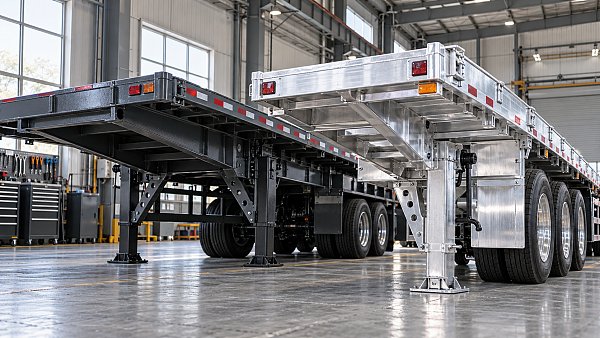
“Steel” and “aluminum” do not describe every component in a trailer. An aluminum model may use steel running gear, landing gear, fasteners, or other components. A steel model may have a wood deck or mixed-material assemblies. Combination designs can place each material where it serves a particular structural or maintenance purpose.
Request a complete bill of specification and an as-equipped tare weight for each candidate. A base-model weight is not a reliable purchasing figure when the working trailer needs different axles, tires, decking, storage, bulkhead equipment, or load-securement fittings.
- Match dimensions and running gear: deck length, width, height, axle arrangement, suspension, tires, and braking equipment should support the same duty.
- Match structural capability: compare distributed-load ratings, concentrated-load ratings, loading positions, and permitted loading methods.
- Match operating equipment: include ramps, toolboxes, spare wheels, winches, chains, straps, dunnage, and any required headboard.
- Check rating conditions: confirm whether capacities assume particular support positions, load footprints, or operating restrictions.
A lower tare weight is only valuable if the trailer still handles the intended freight. Reducing mass by selecting a specification that cannot accept the fleet’s machinery, steel products, or loading equipment is not an equivalent comparison.
When lower tare becomes usable payload
At the simplest level, available payload equals the permitted operating combination weight minus the actual operating empty weight. That calculation is only the first gate. Individual axle limits, axle-group limits, tire ratings, trailer ratings, and route restrictions can impose a lower usable payload.
Assess payload as the maximum cargo weight that satisfies all applicable constraints at the same time. A gross-weight allowance does not override an overloaded axle group or an exceeded structural rating. Confirm the rules for the operating country, route, vehicle configuration, and intended service date rather than applying a limit from another market.
The dense-freight opportunity
Loads of dense material can reach a weight ceiling while deck space remains available. Here, a lighter trailer may allow more freight on the same trip, provided the cargo can be positioned legally and the shipper can supply the additional quantity. The benefit is strongest when this pattern repeats rather than occurring occasionally.
Review dispatched weights alongside scale records, load plans, and invoices. A trailer that frequently operates near its legal limit is a candidate for further analysis, but the billing method still matters. A fixed payment per trip may provide no immediate revenue increase for carrying extra weight unless it changes trip count, contract terms, or fleet capacity.
The deck-space constraint
Long fabrications, bulky building products, and certain machinery movements may consume the available deck without approaching the weight limit. In that service, lower tare does not automatically create saleable capacity. The business case must instead rest on other measurable differences, such as fuel consumption, maintenance, or residual value.
Do not assign the full nominal weight saving to every trip. Separate weight-limited loads from space-limited, piece-limited, and customer-limited loads, then calculate the benefit only where it can be realized.
Axle distribution can block the gain
A concentrated item may overload a trailer axle group or tractor drive group before the combination reaches its permitted gross weight. A lighter trailer does not necessarily solve this because the location of the weight reduction matters. Compare empty axle weights and evaluate representative cargo positions with the proposed tractor.
Adjustable axle positions, where fitted and permitted, may help distribution, but they are not a substitute for checking coupling geometry, clearances, applicable spacing rules, and structural limits.
Repair costs depend on the damage and the workshop
Steel is not automatically cheap to repair, and aluminum is not automatically uneconomical. A replaceable damaged component can be less troublesome than a distorted main structural member in either material. Access, disassembly, alignment, inspection, refinishing, and transport to the workshop can exceed the cost of the welding itself.
High-strength steels may have restrictions on heating, straightening, or welding. Aluminum repairs need procedures appropriate to the alloy and structural application; welding heat can alter properties around the joint. Neither material should receive an improvised reinforcement simply because a workshop can attach it.
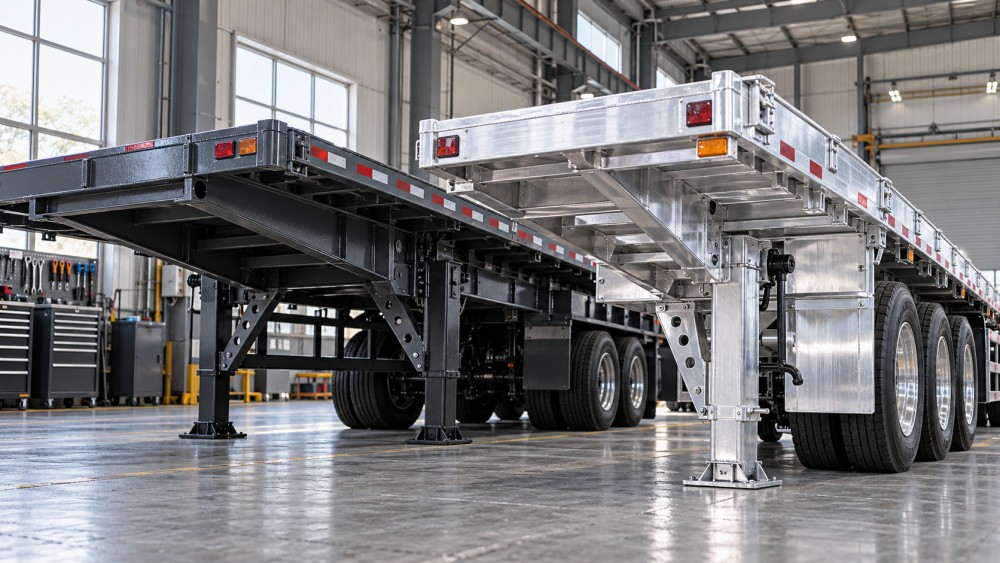
Ask shortlisted suppliers to explain repair routes for likely damage locations: deck edges, crossmembers, main beams, landing-gear attachments, and rear structures. Establish which components are replaceable, what inspection follows repair, and whether the repair affects warranty coverage or rated capability. Main-beam distortion, cracking around critical joints, or suspected overload damage warrants manufacturer or qualified engineering assessment before returning the trailer to service.
Loading practices can outweigh the material advantage
A fleet carrying evenly supported bundled freight faces a different damage pattern from one loading tracked machinery or items with small support footprints. Forklift wheel loads, dropped cargo, dragging, and unsecured dunnage can damage decks and crossmembers even when total cargo weight remains within the headline rating.
For machinery work, obtain the manufacturer’s loading restrictions, including permitted contact areas, wheel or track loads, ramp arrangements, and any required load-spreading equipment. A distributed-load capacity does not establish suitability for a concentrated machine load.
Review damage records by location and cause rather than by repair invoice alone. Repeated deck-edge impacts may justify a different edge design or replaceable protection. Crossmember damage may indicate unsuitable support spacing or loading practice. Purchasing a heavier trailer without correcting those conditions can preserve the same failure pattern.
Corrosive service also changes the comparison. Steel coatings require inspection and repair where abrasion exposes the substrate. Aluminum needs attention at joints, trapped-debris areas, and interfaces with dissimilar metals. Washing and drainage provisions matter for both. Obtain the manufacturer’s cleaning guidance, particularly where aggressive chemicals could damage coatings or materials.
Build the cost model around contribution, not theoretical capacity
Compare both options over the same ownership period and expected utilization. Include acquisition and financing, maintenance, damage repairs, downtime, operating costs, and disposal proceeds. Use consistent assumptions for tractor assignment and duty so that unrelated changes do not appear as material benefits.
Annual payload contribution = additional billable payload per eligible trip × eligible trips per year × net contribution per additional unit of payload.
The net contribution should reflect costs that rise with the extra freight, not simply the invoice rate. Where lower tare reduces the number of trips required for a fixed freight volume, model the avoidable trip costs instead. Do not count the same benefit twice as both extra revenue and eliminated trips.
Then compare the annual contribution with the annualized purchase premium and differences in repairs, maintenance, downtime, and residual value. Fuel savings should be assessed separately. When the lighter trailer carries additional cargo up to the same operating weight, the combination is not necessarily lighter on the road; a fuel-saving assumption based on reduced gross weight would be misleading.
Use three operating cases:
- Conservative: fewer weight-limited trips, limited recovery of extra payload revenue, and a longer specialist-repair delay.
- Expected: the fleet’s documented freight mix, normal workshop access, and supportable resale assumptions.
- High-utilization: sustained demand for additional payload, without assuming every dispatched load can use it.
Repair estimates should include labor, parts, transport, inspection, and lost contribution during unavailability. Use fleet records, workshop quotations, and supplier information rather than treating a generic material-based maintenance allowance as evidence. Avoid combining lost revenue and replacement-trailer costs where that would count the same disruption twice.
Resolve the remaining uncertainty before issuing the order
A purchase specification should turn the comparison into verifiable requirements. Request a stated tare-weight basis, component list, structural ratings, concentrated-load conditions, warranty exclusions, and written repair guidance. Clarify whether delivery weight includes all ordered equipment and operating accessories.
For unfamiliar designs, inspect critical joints and service-access points with the maintenance team. Check whether routine work requires removing large deck sections, whether replacement crossmembers or deck components are stocked, and how parts can reach the fleet’s operating region. A technically repairable trailer can still be commercially difficult to support.
Ask repair providers whether they can perform the required work, not merely whether they “repair aluminum” or “repair steel.” Relevant capability includes material identification, approved procedures where required, alignment control, suitable inspection, and documentation of completed structural repairs.
Favor aluminum when verified weight savings repeatedly become paid payload and repair support is credible. Favor steel when payload headroom is rarely sold, the specification better suits damaging loading conditions, or its support network materially reduces expected downtime. Where only certain lanes are weight-constrained, allocate lighter equipment to those duties rather than applying one material choice across the fleet. The deciding figure is the recoverable operating value of the actual specification—not the advertised weight difference alone.
Send us a message
Related News
 Maintenance & TCORepair or Replace Commercial Trucks? Using Downtime and Cost per MileCommercial Trucks: repair or replace? Compare downtime, cost per mile, and future ownership costs to make smarter fleet decisions. Discover when repair pays and replacement wins.MORE+
 Medium-Duty Delivery TrucksSizing Commercial Trucks for Urban Delivery: Payload vs. Cargo VolumeSize Commercial Trucks for urban delivery with confidence. Compare payload, usable cargo volume, axle limits, and route access to choose the right fit and avoid costly extra trips.MORE+
 Highway Truck TractorsUsed Tractor Truck Inspection: Engine Hours, Fifth Wheel, and FrameBuying used Tractor Trucks? Learn how to verify engine hours, inspect fifth-wheel wear, and spot frame damage to avoid costly surprises and buy with confidence.MORE+
 Highway Truck TractorsTractor Truck Axle Ratios: Balancing Highway Fuel Use and Hill StartsTractor Trucks axle ratios affect fuel use and loaded hill starts. Learn how to compare gearing, verify launch capability, and choose a powertrain that fits your routes.MORE+
 Technology & Performance BenchmarkHow Semi-Trailer Axle Position Changes Kingpin Load and Axle WeightSemi-Trailers: Learn how axle position changes kingpin load and axle weight. Explore practical calculations to balance loads, avoid overloads, and choose the right setup.MORE+
 Box SemitrailersDry Van or Curtainsider? Choosing Semi-Trailers for Pallet FreightCompare Semi-Trailers for pallet freight: dry vans vs. curtainsiders. Discover which loading options, cargo protection, and operating costs best fit your routes before you buy.MORE+
 Full TrailersFull Trailer Coupling Checks: Drawbar Wear, Locking, and Safety ChainsFull Trailers need secure couplings for safer dispatch. Learn how to check drawbar wear, verify locking, and inspect safety chains to spot defects before they put your fleet at risk.MORE+
 Full TrailersWhat Is a Full Trailer? Axle Support, Drawbars, and Common UsesExplore how Full Trailers support loads, use drawbars, and compare with semitrailers. Discover common uses and key operating factors to choose the right setup for your freight needs.MORE+
 Refrigerated SemitrailersBuying Refrigerated Trailers for Multi-Temperature Food DeliveryBuying Refrigerated Trailers for multi-temperature food delivery? Compare layouts, cooling capacity, payload and lifetime costs to protect food quality and choose the right fit for your routes.MORE+
 Refrigerated SemitrailersRefrigerated Trailer Temperature Swings: Airflow or Unit Failure?Refrigerated Trailers showing temperature swings? Learn how to distinguish airflow issues from unit faults, protect cargo, and avoid costly repairs with practical diagnostic checks.MORE+
 Driver Assistance & SafetyFlatbed Trailer Load Securement: Preventing Steel Coil MovementFlatbed Trailers: Learn how to prevent steel coil movement with proper cradles, rated tiedowns, and load checks. Explore practical steps for safer, more confident dispatch.MORE+
 Flatbed & Lowbed SemitrailersSteel vs. Aluminum Flatbed Trailers: Payload Gains and Repair CostsCompare steel vs. aluminum Flatbed Trailers for usable payload gains, repair costs, and downtime. Discover which option delivers better value for your fleet.MORE+
 Routing & Capacity PlanningPlanning Lowboy Trailer Moves: Ground Clearance, Grades, and Site AccessPlanning moves with Lowboy Trailers? Learn how to assess ground clearance, grades, traction, and site access to avoid costly delays and keep equipment deliveries on track.MORE+
 Flatbed & Lowbed SemitrailersChoosing a Lowboy Trailer for Excavators: Deck Height and Load CapacityCompare Lowboy Trailers for excavators with expert guidance on deck height, load capacity, and axle limits. Find the right fit to avoid costly mismatches and plan your next move.MORE+
 Maintenance & TCOWhen Do Electric Trucks Pay Off? A Depot-Based Fleet TCO AnalysisWhen do Electric Trucks pay off? Explore depot-based fleet TCO, charging costs, and break-even factors to identify profitable routes and invest with confidence.MORE+
 Electric Heavy TrucksCan Electric Trucks Complete Your Routes? Payload, Range, and ChargingCan Electric Trucks handle your routes? Learn how payload, real-world range, and charging windows affect fleet performance—and discover what to check before you invest.MORE+
 Policy, Standards & ComplianceFMVSS 121 for Truck Air Brakes: Stopping Distance and Test RequirementsCommercial Vehicle Braking Systems: Understand FMVSS 121 stopping distances, test conditions, and compliance evidence to compare truck air brakes and make smarter fleet decisions.MORE+
 Braking & Electronic ControlsTruck Air Brake Fade on Long Descents: Causes and PreventionCommercial Vehicle Braking Systems can lose stopping power on long descents. Learn brake fade causes, warning signs, and prevention strategies to keep your truck under control.MORE+
 Axles & SuspensionWhy Truck Air Suspension Sags Overnight: Leak Diagnosis and RepairCommercial Vehicle Suspension Systems sagging overnight? Learn to pinpoint air leaks, identify valve faults, and verify repairs before replacing costly parts. Get the diagnostic guide.MORE+
 Axles & SuspensionAir vs. Leaf Spring Suspension for Trucks on Rough Delivery RoutesCommercial Vehicle Suspension Systems: compare air and leaf springs for rough delivery routes. Discover how payload, ride control, and maintenance shape the right truck suspension choice.MORE+