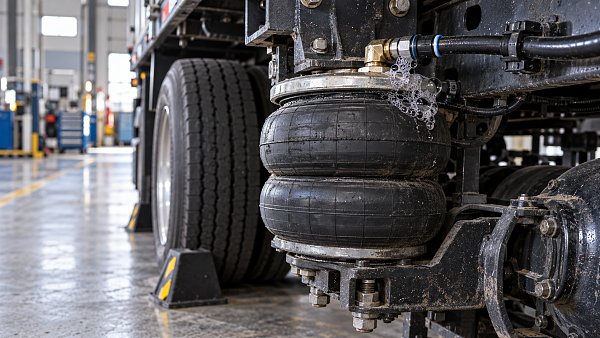
Full Trailer Coupling Checks: Drawbar Wear, Locking, and Safety Chains
Full Trailer Coupling Checks: Drawbar Wear, Locking, and Safety Chains
A coupling defect on full trailers can turn a routine dispatch into a serious safety incident. A drawbar may appear connected while the locking mechanism is only partly engaged. An eye can look serviceable from above yet have significant wear on its lower contact surface. A safety chain may be present but attached to a point that was never designed to retain a separated trailer.
Effective inspection therefore needs more than a glance and a tick on a dispatch sheet. It requires identifying the coupling arrangement, checking wear against the correct manufacturer limits, confirming positive locking, and examining secondary retention where specified. The release decision should be supported by evidence—not by the fact that the same combination completed yesterday’s route.
Start with the actual truck–trailer combination
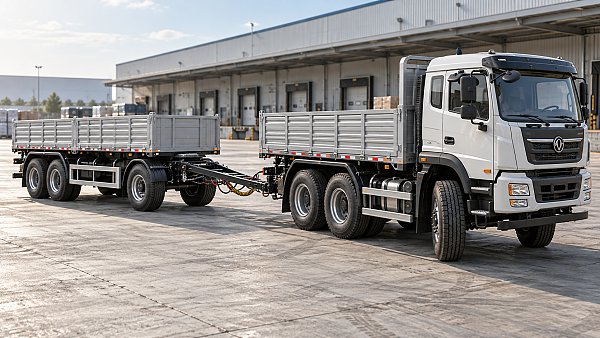
Full trailers generally carry their weight on their own axles and transmit towing forces through a drawbar. That does not make their coupling systems interchangeable. Automatic pin couplings, hook-and-eye arrangements, and other approved systems have different wear surfaces, locking features, articulation limits, and maintenance requirements. Center-axle trailers and converter dollies may require different checks even when the hardware looks familiar.
Before inspecting, identify the coupling manufacturer and model, drawbar eye specification, mounting arrangement, and applicable operating instructions. Confirm that the components are approved for use together. A pin entering an eye is not proof of compatibility: eye geometry, bushing design, rated capacity, and permissible movement all matter.
Capacity checks must address the combination, not just the trailer’s nominal payload. Depending on the design, relevant ratings may include D or Dc values, vertical-load ratings, and other manufacturer-specified limits. These are not substitutes for one another. If identification plates are unreadable or compatibility records are missing, obtain confirmation before release rather than estimating suitability from component size.
Read drawbar wear as a pattern, not a single measurement
Prepare the inspection with the combination secured against unintended movement on suitable ground. Follow the manufacturer’s procedure for coupling, uncoupling, and supporting the drawbar. Keep people clear of the space between vehicles during movement, and do not place hands inside a coupling throat or near a mechanism that could close unexpectedly.
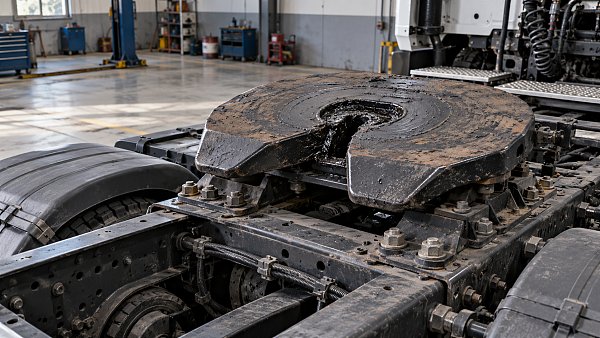
Clean enough dirt and excess grease from the eye and coupling to expose the working surfaces. Look for ovality, local thinning, scoring, displaced metal, cracks, and distortion. Uneven wear can point to misalignment, incompatible parts, restricted articulation, or repeated shock loading. Inspect the mating component as well; replacing an eye without checking the worn pin or hook can leave the underlying problem unresolved.
Measure at the locations specified in the service documentation, using the prescribed gauge or suitable calibrated equipment. Record the actual readings and their positions. A single accessible measurement may miss the most heavily worn area, particularly where contact is concentrated on the underside or fore-and-aft faces.
There is no universal acceptable drawbar eye diameter or coupling clearance for every full trailer. Some designs use replaceable bushes; others have different wear criteria. Compare results with the current instructions for the exact component, including any required measurement method. “Still connects” is not an acceptance limit.
Extend the inspection beyond the eye. Check the drawbar structure, mounting brackets, pivots where fitted, fasteners, and adjacent frame areas. Rust trails, fretting marks, disturbed paint, or witness-mark movement can indicate a connection that needs investigation. Suspected cracks or distortion require removal from service pending competent assessment; do not grind or weld load-bearing parts unless an approved repair procedure permits it.
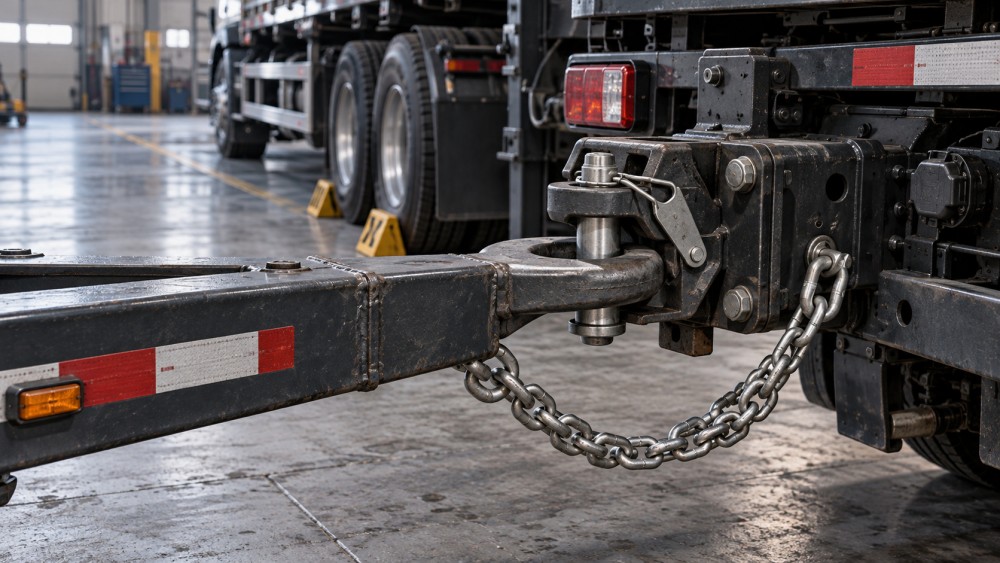
Verify locking directly—sound alone proves little
An audible click can be useful feedback, but it is not a release criterion. Debris, misalignment, worn parts, or a sticking mechanism can prevent full engagement even when coupling sounds normal. The inspection must establish that the primary retaining element is fully seated and that any secondary lock has reached its specified position.
Use the manufacturer’s stated indicators: these may include a control-pin position, handle position, inspection opening, or another mechanical confirmation. Do not assume that every coupling uses the same indication logic. Where remote indication is fitted, verify its meaning and complete any physical checks required by the manufacturer. An in-cab signal should not replace a prescribed visual inspection.
- Check that the eye is correctly seated, rather than resting against or above the intended engagement position.
- Confirm that the pin, jaw, or hook and its locking features reach their specified fully closed positions.
- Inspect accessible springs, handles, retainers, and protective parts for damage, missing pieces, or interference.
- Verify that pneumatic, electrical, or remote-release controls, where fitted, are in the required safe operating state.
If the approved procedure includes a controlled pull test, conduct it only after the initial engagement checks, with personnel clear and the vehicles secured and operated as instructed. It supplements inspection; it does not prove that a worn component is within tolerance or that every lock feature is sound. Never improvise a test by jerking the combination.
A coupling that needs repeated impacts, hammering, or an improvised restraint to remain closed is not ready for dispatch. Investigate the cause rather than treating unusual effort as a characteristic of older equipment.
Safety chains must be suitable, sound, and correctly routed
Safety chains and other secondary retention devices are not specified identically across all trailer categories and markets. Their requirement, rating, number, attachment method, and routing depend on the approved configuration and applicable local rules. Do not assume that a setup used on a light trailer is suitable for a heavy commercial drawbar combination.
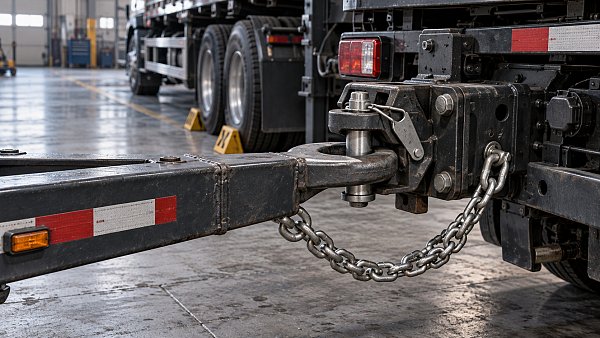
Where chains are required, inspect the complete load path: chain links, connectors, hooks, retaining features, attachment brackets, and supporting structure. Look for wear at contact points, stretched or distorted links, cracks, severe corrosion, unauthorized weld repairs, and connectors that cannot close correctly. An intact chain attached to a damaged bracket does not provide reliable retention.
Verify component identification and suitability against the approved specification. Thickness alone does not establish chain capacity, and an unverified replacement connector can undermine an otherwise suitable assembly. Do not shorten a chain with knots, makeshift bolts, or other unapproved arrangements.
Routing needs enough freedom for the permitted steering and articulation without dragging, snagging, or fouling the drawbar. Excess slack can create its own hazards. Crossing chains beneath the drawbar is required or recommended in some arrangements, but should not be applied as a universal rule. Follow the requirements for that vehicle and coupling system, including designated attachment points.
Keep retention devices distinct from braking connections. An emergency braking or breakaway arrangement performs a different function and is not automatically a substitute for chains. Check its installation and operation under the relevant procedure. Air hoses and electrical cables also need clearance through articulation; they must not become unintended restraints.
Turn inspection findings into a clear release decision
A useful defect record allows another competent person to understand what was found without repeating the entire inspection. “Coupling worn” is too vague. Record the truck and trailer identities, component model, inspection date, measured wear, applicable limit, and the document revision used. Photographs should show both the defect location and enough surrounding detail to identify it.
Separate confirmed failures from unresolved questions. A measurement beyond the manufacturer’s rejection limit is a failed check. An unreadable rating plate or unidentified replacement eye is an unresolved suitability issue. Both can prevent release, but they require different corrective actions: one may need component replacement, while the other needs traceable technical confirmation.
Hold the equipment when locking cannot be positively verified, a load-bearing part is cracked or distorted, a specified retention device is missing or defective, or compatibility remains uncertain. Do not let dispatch urgency become an informal acceptance standard. After repair, reinspection should cover the affected assembly and its function—not merely confirm that a replacement part has been fitted.
Use recurring defects to change the maintenance plan
Pre-dispatch checks and scheduled workshop inspections serve different purposes. Drivers need a practical way to confirm engagement and spot visible damage. Workshop personnel need access, measurement tools, technical limits, and authority to investigate wear. One checklist should not blur those responsibilities or imply that a walk-around can replace dimensional inspection.
Repeated wear or locking complaints should trigger a review of operating conditions and maintenance practice. Frequent coupling cycles, contamination, rough access roads, alignment problems, and lubrication errors can justify closer monitoring within manufacturer guidance. Check the specified lubricant and service method rather than assuming that more grease will correct stiffness or excessive play.
For GRTE, planned as an independent global information portal for commercial road equipment, this is where practical comparisons matter: country, coupling model, trailer configuration, freight duty, and the effective date of any cited requirement should accompany guidance. A rule or service limit from one market should not silently become advice for every fleet.
Before releasing a full trailer, the responsible team should be able to establish three things: the components are compatible, measured condition is acceptable, and the complete locking and specified retention systems are correctly engaged. If any answer depends on guesswork, obtain the missing measurement, instruction, or technical approval before dispatch.
Send us a message
Related News
 Maintenance & TCORepair or Replace Commercial Trucks? Using Downtime and Cost per MileCommercial Trucks: repair or replace? Compare downtime, cost per mile, and future ownership costs to make smarter fleet decisions. Discover when repair pays and replacement wins.MORE+
 Medium-Duty Delivery TrucksSizing Commercial Trucks for Urban Delivery: Payload vs. Cargo VolumeSize Commercial Trucks for urban delivery with confidence. Compare payload, usable cargo volume, axle limits, and route access to choose the right fit and avoid costly extra trips.MORE+
 Highway Truck TractorsUsed Tractor Truck Inspection: Engine Hours, Fifth Wheel, and FrameBuying used Tractor Trucks? Learn how to verify engine hours, inspect fifth-wheel wear, and spot frame damage to avoid costly surprises and buy with confidence.MORE+
 Highway Truck TractorsTractor Truck Axle Ratios: Balancing Highway Fuel Use and Hill StartsTractor Trucks axle ratios affect fuel use and loaded hill starts. Learn how to compare gearing, verify launch capability, and choose a powertrain that fits your routes.MORE+
 Technology & Performance BenchmarkHow Semi-Trailer Axle Position Changes Kingpin Load and Axle WeightSemi-Trailers: Learn how axle position changes kingpin load and axle weight. Explore practical calculations to balance loads, avoid overloads, and choose the right setup.MORE+
 Box SemitrailersDry Van or Curtainsider? Choosing Semi-Trailers for Pallet FreightCompare Semi-Trailers for pallet freight: dry vans vs. curtainsiders. Discover which loading options, cargo protection, and operating costs best fit your routes before you buy.MORE+
 Full TrailersFull Trailer Coupling Checks: Drawbar Wear, Locking, and Safety ChainsFull Trailers need secure couplings for safer dispatch. Learn how to check drawbar wear, verify locking, and inspect safety chains to spot defects before they put your fleet at risk.MORE+
 Full TrailersWhat Is a Full Trailer? Axle Support, Drawbars, and Common UsesExplore how Full Trailers support loads, use drawbars, and compare with semitrailers. Discover common uses and key operating factors to choose the right setup for your freight needs.MORE+
 Refrigerated SemitrailersBuying Refrigerated Trailers for Multi-Temperature Food DeliveryBuying Refrigerated Trailers for multi-temperature food delivery? Compare layouts, cooling capacity, payload and lifetime costs to protect food quality and choose the right fit for your routes.MORE+
 Refrigerated SemitrailersRefrigerated Trailer Temperature Swings: Airflow or Unit Failure?Refrigerated Trailers showing temperature swings? Learn how to distinguish airflow issues from unit faults, protect cargo, and avoid costly repairs with practical diagnostic checks.MORE+
 Driver Assistance & SafetyFlatbed Trailer Load Securement: Preventing Steel Coil MovementFlatbed Trailers: Learn how to prevent steel coil movement with proper cradles, rated tiedowns, and load checks. Explore practical steps for safer, more confident dispatch.MORE+
 Flatbed & Lowbed SemitrailersSteel vs. Aluminum Flatbed Trailers: Payload Gains and Repair CostsCompare steel vs. aluminum Flatbed Trailers for usable payload gains, repair costs, and downtime. Discover which option delivers better value for your fleet.MORE+
 Routing & Capacity PlanningPlanning Lowboy Trailer Moves: Ground Clearance, Grades, and Site AccessPlanning moves with Lowboy Trailers? Learn how to assess ground clearance, grades, traction, and site access to avoid costly delays and keep equipment deliveries on track.MORE+
 Flatbed & Lowbed SemitrailersChoosing a Lowboy Trailer for Excavators: Deck Height and Load CapacityCompare Lowboy Trailers for excavators with expert guidance on deck height, load capacity, and axle limits. Find the right fit to avoid costly mismatches and plan your next move.MORE+
 Maintenance & TCOWhen Do Electric Trucks Pay Off? A Depot-Based Fleet TCO AnalysisWhen do Electric Trucks pay off? Explore depot-based fleet TCO, charging costs, and break-even factors to identify profitable routes and invest with confidence.MORE+
 Electric Heavy TrucksCan Electric Trucks Complete Your Routes? Payload, Range, and ChargingCan Electric Trucks handle your routes? Learn how payload, real-world range, and charging windows affect fleet performance—and discover what to check before you invest.MORE+
 Policy, Standards & ComplianceFMVSS 121 for Truck Air Brakes: Stopping Distance and Test RequirementsCommercial Vehicle Braking Systems: Understand FMVSS 121 stopping distances, test conditions, and compliance evidence to compare truck air brakes and make smarter fleet decisions.MORE+
 Braking & Electronic ControlsTruck Air Brake Fade on Long Descents: Causes and PreventionCommercial Vehicle Braking Systems can lose stopping power on long descents. Learn brake fade causes, warning signs, and prevention strategies to keep your truck under control.MORE+
 Axles & SuspensionWhy Truck Air Suspension Sags Overnight: Leak Diagnosis and RepairCommercial Vehicle Suspension Systems sagging overnight? Learn to pinpoint air leaks, identify valve faults, and verify repairs before replacing costly parts. Get the diagnostic guide.MORE+
 Axles & SuspensionAir vs. Leaf Spring Suspension for Trucks on Rough Delivery RoutesCommercial Vehicle Suspension Systems: compare air and leaf springs for rough delivery routes. Discover how payload, ride control, and maintenance shape the right truck suspension choice.MORE+