Refrigerated Trailer Temperature Swings: Airflow or Unit Failure?
Refrigerated Trailer Temperature Swings: Airflow or Unit Failure?
A temperature alarm does not automatically mean the refrigeration unit is failing. In refrigerated trailers, a collapsed air chute, blocked return opening, or poorly positioned load can leave cargo warm while the unit continues producing cold air. Replacing refrigeration components will not correct that distribution problem.
The reverse is also possible: an apparent loading problem may conceal a fan fault, iced evaporator, or loss of cooling capacity. The useful distinction is not simply “airflow versus machinery.” It is whether the system can produce cooling, move it through the trailer, and control it correctly. Comparing supply-air, return-air, and cargo temperatures helps separate those questions before parts are replaced.
Establish what is actually swinging
Start by identifying the source of the complaint. Is the driver watching the controller display, is a remote logger reporting excursions, or has someone measured warm product at delivery? These readings describe different things and should not be treated as interchangeable evidence.
Supply air is air leaving the evaporator toward the load. Return air is air arriving back at the refrigeration unit after circulating through the trailer. Cargo temperature concerns the product itself, although a logger positioned beside a carton usually measures local air rather than product core temperature.
Air reacts quickly to door openings, cooling cycles, and defrost. Product temperature normally changes more slowly, depending on packaging, mass, and exposure. A brief air-temperature rise therefore does not prove cargo damage. Equally, cold air near the unit does not prove that pallets at the rear are within specification.
Before troubleshooting, confirm the required cargo temperature range, accepted measurement method, and excursion procedure. If product integrity is uncertain, notify the responsible cargo-quality team and arrange suitable temperature-controlled holding where necessary. Do not keep sensitive freight in a suspect trailer merely to complete a diagnostic run.
Read the operating history before opening the toolbox
Record the setpoint, operating mode, ambient conditions, loading temperature, door activity, defrost events, and active or stored alarms. Check whether the controller displays supply air, return air, or another value. Also confirm which sensor the particular unit uses for control in the selected mode; that logic varies by model and application.
A repeated rise aligned with delivery stops points toward infiltration or operating practice. A rise during recorded defrost may be expected, but prolonged recovery still needs investigation. Regular fluctuations under start-stop operation can reflect normal control behavior rather than a fault, provided the mode is suitable for the cargo and temperatures remain acceptable.
Compare the trailer probe with an independent instrument at the same location, allowing for sensor response time. Check calibration status and inspect wiring, connectors, and probe mounting. A displaced probe touching a cold surface can produce misleading readings even when the refrigeration circuit is healthy.
Use temperature differences as clues, not pass-or-fail limits
Take supply and return readings during the same stable cooling period, outside defrost, and note whether the unit is pulling down temperature or maintaining it. Add independent measurements near the front, middle, and rear of the load where access is safe. Keep probe positions consistent so later readings are comparable.
The supply-to-return temperature difference can help explain what is happening, but there is no universal acceptable value for every trailer. Fan speed, humidity, operating mode, cargo heat load, refrigerant system design, and airflow restriction all affect it. Use manufacturer test conditions rather than an unsupported rule of thumb.
These patterns narrow the investigation; they do not establish a diagnosis alone. In particular, a large temperature difference does not necessarily mean strong performance. Reduced airflow can make the air leaving the coil colder while reducing the total heat removed from the trailer.
Trace the complete air circuit
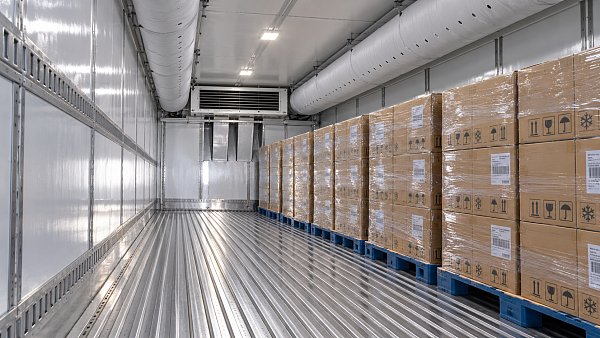
On a typical top-air delivery arrangement, cooled air travels along the upper distribution path, reaches the load area, and returns toward the evaporator through the routes provided by the body and loading configuration. The exact path depends on the trailer design. Multi-temperature bodies, movable bulkheads, and remote evaporators require compartment-specific checks.
Inspect the air chute for tears, loose connections, collapsed sections, and repairs that alter its outlet pattern. A chute may look intact at the front while failing farther back. Check the evaporator return opening and bulkhead clearance for cartons, wrapping film, debris, or shifted pallets.
Then follow the path through the load. Freight stacked above the designated load line can obstruct distribution. Packaging pressed against walls may close intended passages. Where floor channels form part of the return route, damaged flooring, loose sheets, or debris can restrict circulation.
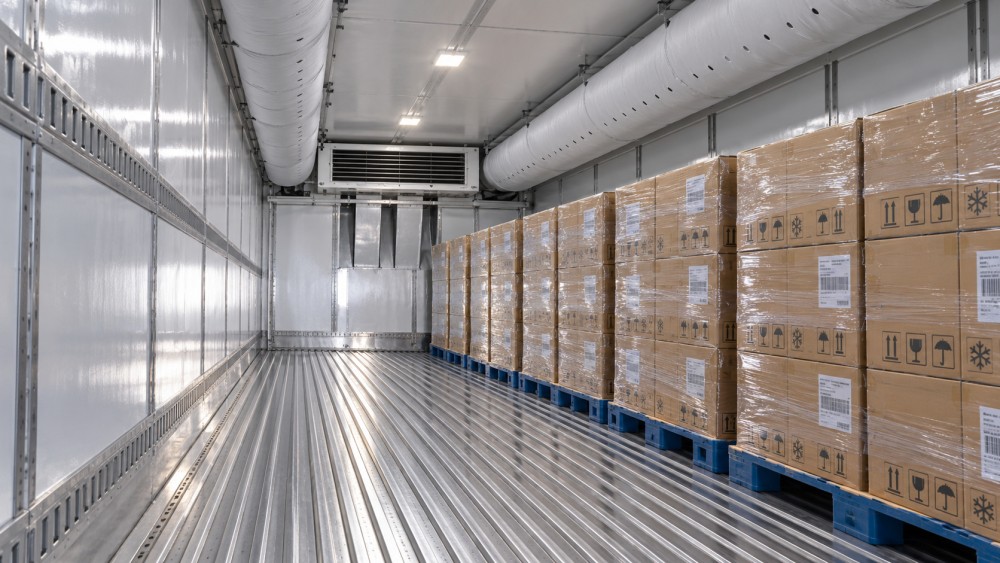
Do not prescribe a generic clearance for every refrigerated trailer. Confirm the body builder’s loading guidance and the refrigeration manufacturer’s installation requirements. Pallet positions must preserve airflow without compromising load restraint, axle loads, or safe unloading.
Check doors, seals, drains, and body damage as well. Warm, humid air entering through a poor seal adds heat and moisture, potentially increasing evaporator icing. For multi-drop work, relate recovery time to actual door-open periods and follow the specified door-opening procedure rather than assuming one operating practice suits every unit.
When airflow symptoms come from a unit fault
Not every airflow problem is a loading problem. An evaporator fan can be stopped, running incorrectly, or delivering less air than expected. Ice can obstruct the coil, while damaged blades or fan-control faults can reduce distribution. These conditions require equipment repair even if the refrigeration circuit can still generate cold air.
An iced evaporator deserves a cause investigation, not just a defrost and release. Possible contributors include moisture infiltration, restricted airflow, and defrost-control or termination faults. Inspect the ice pattern, drainage, fan operation, and recorded defrost behavior using the manufacturer’s procedure.
Move toward refrigeration-system testing when the air paths are clear, fans operate correctly, the control demand is verified, and supply air still fails to cool as expected. Persistent protective shutdowns, repeat alarms, abnormal compressor behavior, or failure under both engine-driven and standby operation can help direct testing. A fault appearing only on standby should prompt checks of that power source and its associated controls.
Check condenser cleanliness and airflow, available power, and commanded versus actual operation before blaming refrigerant charge. Pressure readings require interpretation against refrigerant type, ambient conditions, load, and operating state. Low suction pressure alone does not prove a refrigerant shortage; restricted evaporator airflow can also lower it.
Refrigerant handling, electrical measurements, and work near moving components belong with qualified personnel using the applicable service procedures. Isolate equipment before physical inspection. Do not bypass protective controls to force a result or add refrigerant simply because the trailer is warm.
Prove the correction under representative conditions
After correcting an obstruction, restoring a chute, or completing a repair, repeat the measurements with documented probe positions and comparable operating conditions. Look for recovery across the load, not just a satisfactory controller display. An empty trailer pull-down test can support diagnosis, but it does not demonstrate acceptable distribution through the original loaded configuration.
Also distinguish transport refrigeration from product chilling. Warm-loaded freight can impose a substantial heat load, and a unit intended primarily to maintain temperature should not automatically be expected to bring it down within a delivery schedule. Verify the actual cargo requirement and equipment capability before treating slow pull-down as a defect.
Record the trailer configuration, unit model, load arrangement, operating mode, ambient conditions, alarms, and before-and-after readings. Include what changed and what remains unverified. “Temperature normal” is a weak handover note if the original problem occurred only after several delivery stops.
GRTE’s planned independent coverage of commercial road equipment will examine these equipment-and-operation relationships alongside maintenance requirements and lifetime cost. For fleets, that perspective matters: a capable refrigeration unit cannot compensate for an incompatible body arrangement or a loading practice that repeatedly blocks its air circuit.
Before authorizing replacement parts, establish whether cooling is being produced, whether sufficient air reaches the cargo, and whether the controls are responding to trustworthy measurements. Release the trailer only against a defined acceptance check appropriate to its next duty—not because one cold reading appeared near the evaporator.
Send us a message
Related News
 Maintenance & TCORepair or Replace Commercial Trucks? Using Downtime and Cost per MileCommercial Trucks: repair or replace? Compare downtime, cost per mile, and future ownership costs to make smarter fleet decisions. Discover when repair pays and replacement wins.MORE+
 Medium-Duty Delivery TrucksSizing Commercial Trucks for Urban Delivery: Payload vs. Cargo VolumeSize Commercial Trucks for urban delivery with confidence. Compare payload, usable cargo volume, axle limits, and route access to choose the right fit and avoid costly extra trips.MORE+
 Highway Truck TractorsUsed Tractor Truck Inspection: Engine Hours, Fifth Wheel, and FrameBuying used Tractor Trucks? Learn how to verify engine hours, inspect fifth-wheel wear, and spot frame damage to avoid costly surprises and buy with confidence.MORE+
 Highway Truck TractorsTractor Truck Axle Ratios: Balancing Highway Fuel Use and Hill StartsTractor Trucks axle ratios affect fuel use and loaded hill starts. Learn how to compare gearing, verify launch capability, and choose a powertrain that fits your routes.MORE+
 Technology & Performance BenchmarkHow Semi-Trailer Axle Position Changes Kingpin Load and Axle WeightSemi-Trailers: Learn how axle position changes kingpin load and axle weight. Explore practical calculations to balance loads, avoid overloads, and choose the right setup.MORE+
 Box SemitrailersDry Van or Curtainsider? Choosing Semi-Trailers for Pallet FreightCompare Semi-Trailers for pallet freight: dry vans vs. curtainsiders. Discover which loading options, cargo protection, and operating costs best fit your routes before you buy.MORE+
 Full TrailersFull Trailer Coupling Checks: Drawbar Wear, Locking, and Safety ChainsFull Trailers need secure couplings for safer dispatch. Learn how to check drawbar wear, verify locking, and inspect safety chains to spot defects before they put your fleet at risk.MORE+
 Full TrailersWhat Is a Full Trailer? Axle Support, Drawbars, and Common UsesExplore how Full Trailers support loads, use drawbars, and compare with semitrailers. Discover common uses and key operating factors to choose the right setup for your freight needs.MORE+
 Refrigerated SemitrailersBuying Refrigerated Trailers for Multi-Temperature Food DeliveryBuying Refrigerated Trailers for multi-temperature food delivery? Compare layouts, cooling capacity, payload and lifetime costs to protect food quality and choose the right fit for your routes.MORE+
 Refrigerated SemitrailersRefrigerated Trailer Temperature Swings: Airflow or Unit Failure?Refrigerated Trailers showing temperature swings? Learn how to distinguish airflow issues from unit faults, protect cargo, and avoid costly repairs with practical diagnostic checks.MORE+
 Driver Assistance & SafetyFlatbed Trailer Load Securement: Preventing Steel Coil MovementFlatbed Trailers: Learn how to prevent steel coil movement with proper cradles, rated tiedowns, and load checks. Explore practical steps for safer, more confident dispatch.MORE+
 Flatbed & Lowbed SemitrailersSteel vs. Aluminum Flatbed Trailers: Payload Gains and Repair CostsCompare steel vs. aluminum Flatbed Trailers for usable payload gains, repair costs, and downtime. Discover which option delivers better value for your fleet.MORE+
 Routing & Capacity PlanningPlanning Lowboy Trailer Moves: Ground Clearance, Grades, and Site AccessPlanning moves with Lowboy Trailers? Learn how to assess ground clearance, grades, traction, and site access to avoid costly delays and keep equipment deliveries on track.MORE+
 Flatbed & Lowbed SemitrailersChoosing a Lowboy Trailer for Excavators: Deck Height and Load CapacityCompare Lowboy Trailers for excavators with expert guidance on deck height, load capacity, and axle limits. Find the right fit to avoid costly mismatches and plan your next move.MORE+
 Maintenance & TCOWhen Do Electric Trucks Pay Off? A Depot-Based Fleet TCO AnalysisWhen do Electric Trucks pay off? Explore depot-based fleet TCO, charging costs, and break-even factors to identify profitable routes and invest with confidence.MORE+
 Electric Heavy TrucksCan Electric Trucks Complete Your Routes? Payload, Range, and ChargingCan Electric Trucks handle your routes? Learn how payload, real-world range, and charging windows affect fleet performance—and discover what to check before you invest.MORE+
 Policy, Standards & ComplianceFMVSS 121 for Truck Air Brakes: Stopping Distance and Test RequirementsCommercial Vehicle Braking Systems: Understand FMVSS 121 stopping distances, test conditions, and compliance evidence to compare truck air brakes and make smarter fleet decisions.MORE+
 Braking & Electronic ControlsTruck Air Brake Fade on Long Descents: Causes and PreventionCommercial Vehicle Braking Systems can lose stopping power on long descents. Learn brake fade causes, warning signs, and prevention strategies to keep your truck under control.MORE+
 Axles & SuspensionWhy Truck Air Suspension Sags Overnight: Leak Diagnosis and RepairCommercial Vehicle Suspension Systems sagging overnight? Learn to pinpoint air leaks, identify valve faults, and verify repairs before replacing costly parts. Get the diagnostic guide.MORE+
 Axles & SuspensionAir vs. Leaf Spring Suspension for Trucks on Rough Delivery RoutesCommercial Vehicle Suspension Systems: compare air and leaf springs for rough delivery routes. Discover how payload, ride control, and maintenance shape the right truck suspension choice.MORE+